
Funding for state labor market information (LMI) offices has fallen behind inflation. States are partners in a cooperative agreement with the U.S. Department of Labor’s Bureau of Labor Statistics (BLS) to collect, process, and publish the wage, employment, and occupational data. BLS combines this data into the nation’s core labor market statistics; the same data employers, community colleges, and policymakers use every day. Congress funds the state share of this partnership through the Federal Unemployment Tax Act (FUTA), the tax employers pay into the Employment Security Administration Account.
Why now. The federal funding line for this partnership is fully committed to current data production. There is no development capacity in it, so data modernization and enhancement efforts are severely hampered.
THE ASK
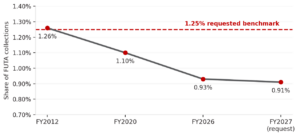
- Restore the state labor market information share of FUTA collections to 1.25 percent. The share stood at 1.26 percent in FY 2012 when the most recent FUTA tax rate change occurred, but it is now 0.93 percent and declining further each year. This restores it to roughly where it was, and the allocation was never cut to get here. It simply stayed flat while collections grew.
- On FY 2026 collections of $7.30 billion, 1.25 percent is $91.3 million. That is about $23 million above the current $68 million line. On the FY 2027 projection of $7.46 billion, 1.25 percent would be $93.3 million.
- No tax legislation is required. FUTA receipts already flow to the Employment Security Administration Account. Appropriators can choose to allocate this revenue based on the growing trust fund already being collected.
- Hold the share, and the line keeps pace. A fixed dollar amount as currently proposed falls further behind every year. A share of collections moves with the growth in covered employment, which is a durable fix for an ever-increasing demand on the data management system.
Figure 1. State LMI share of FUTA collections, FY 2012 to FY 2027 (requested), against the 1.25 percent benchmark.
- Department of Labor. Produce a current-services cost assessment of state LMI responsibilities. Scope one or two specific technology-and-workforce products (e.g., support for an NSF pilot to track worker demands for emerging technology areas like AI) and two or three AI pilots that could be evaluated within a program year. Clarify the use of AI methods and other modern tooling in production statistics.
- Senate appropriations. Set the FY 2028 state LMI allocation at 1.25 percent of projected FUTA collections, about $93 million on the FY 2027 projection, and carry report language establishing that benchmark for future years.
- Senate authorizing committees. No tax legislation is needed. Where the committees can help is durability. Language tying the allocation to a share of receipts under Wagner-Peyser Section 14 purposes (rather than a flat amount) would keep the benchmark from eroding again between appropriations cycles.
WHAT IT WOULD BUILD
- A modernized data collection system. Upgrade the collection instruments, respondent-facing tools, and processing behind the Current Employment Statistics, the Quarterly Census of Employment and Wages, Occupational Employment and Wage Statistics, and Local Area Unemployment Statistics. Reduce the reporting burden on employers. Strengthen the establishment records that UI operations also depend on.
- Tested AI methods that raise productivity. Fund controlled testing in the labor-intensive steps of statistical production: coding, editing, imputation, and quality review. Build validation, documentation, and governance in from the start. Publish what is learned so a method proven in one state can be adopted in all 50, including what does not work.
- New data products on technology and the workforce. Measure how AI and other emerging technologies are changing occupations, skill demand, and hiring. Produce it as a documented complement to the other BLS state data programs at state and substate geography on a published schedule.
WHAT DATA USERS WOULD GET
- Local answers. A national estimate for employment and unemployment does not answer questions for state and local leaders. Employers, community colleges, workforce boards, and state policymakers are asking about their own labor markets.
- Measures that mean the same thing in Ohio as in Arizona, which is what makes the data usable for federal fund allocation and program design.
- In a period of rapid technological change, a data product that arrives late arrives useless.
- Lower burden. The employers who bear the reporting cost are the same people asking for better products. Streamlined reporting supports response rates and therefore data quality.
FOR THE RECORD
- This proposal addresses the FUTA-funded trust fund line. The approximately $4 million in additional BLS general revenue support is an invaluable investment, but it is separate conversation from this request.
- We propose 1.25 percent as a benchmark for appropriations, not an automatic formula. Employment Security Administration Account appropriations properly reflect the Department’s assessment of state needs. The benchmark is a reference point for judging whether the allocation has kept pace.
- The $7,000 FUTA taxable wage cap has not changed since 1983 and is not indexed. Raising it is a separate and longer-term question. If it were raised and the share held, the state LMI line would rise with it. A fully sourced background memorandum and companion workbook carrying the complete FY 2012 to FY 2027 funding series are available from the LMI Institute.